Stay Up To Date On News And
Stories In The Twisted Wire Brush Industry.

LEAN History

Successful LEAN Methodology Implementation Provides a Platform for Businesses to Pursue Cutting-Edge Ideas

  • Stemming from Japan’s “Toyota System”, LEAN Six Sigma has been emerging as an effective manufacturing strategy in the United States
  • Six Sigma allows for data driven improvement, utilizing tools such as the DMAIC process
  • Initiating LEAN into a company not only increases the odds of higher efficiency and production, but completely revolutionizes the company culture into one of continuous improvement
Initially originating in Japan, the concepts of LEAN can be universally applied to nearly any process. Some concepts of LEAN go back as far as the pre-20th century, with ideas such as the “Five Whys,” a strategy to determine root cause, commonly being attributed to Benjamin Franklin. Franklin’s publication, Poor Richard’s Almanac also included many ideas which remain cornerstones of the LEAN philosophy. Industrialist Henry Ford also understood the importance of waste reduction when he established the first mass production assembly lines, emphasizing standardization within processes and pull systems.

In around 1934, Japanese automaker Toyota began utilizing the Just in Time (JIT) methodology, focusing on reducing time within the manufacturing process as well as reducing the strains of inventory management by producer and buyer. Due to the conditions in Japan during the post-war period, they were forced to alter their manufacturing processes and “LEAN out” their companies. This achieved lower inventory levels, while investment in in-process inventories was kept at a minimum. The cost of purchased resources was offset by quickly using them within the manufacturing process through the use of one-piece flow and rudimentary pull systems. Eventually, this methodology gained momentum in the United States and other western countries, evolving into what it is today.

The end goal of LEAN is to reduce waste from processes. Waste, in this case, can be defined as, “Anything other than the minimum amount of equipment, materials, parts, space, and workers time, which are absolutely essential to add value to the product.” There are many tools provided within LEAN ideology, and these tools can be applied in a variety of combinations in order to achieve the desired effect within a company.
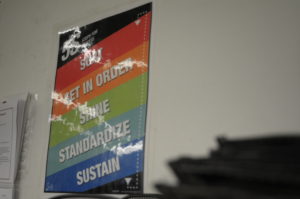
LEAN Six Sigma applications allow Sanderson MacLeod, a Palmer, Massachusetts based manufacturer to produce twisted-wire brushes more efficiently and effectively, ensuring ever-improving intercompany communication, data-driven decision making and individual performance measurement.

The benefits of introducing LEAN initiatives into a manufacturing company are clearly demonstrated through the success of Sanderson MacLeod. Enhanced inventory control systems, product use analysis, and on-floor production optimization save customers money in innovative ways. Sanderson MacLeod has been widely recognized as a LEAN Manufacturer, leading to awards such as Business of the Year, Employer of Choice, the Super 60 Award, ABMA’s coveted William A. Cordes Innovation Excellence Award and most recently the Associated Industries of Massachusetts Sustainability Award.
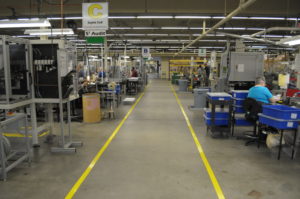
Sanderson has reduced scrap to below Sanderson has reduced scrap to below 2% of parts produced, down nearly 10% over a ten-year span. Overproduction is also considered an area of waste, and through its LEAN practices, Sanderson has dropped from +/- 15% over/under production to less than .005%, which allows the company to maximize equipment utilization, labor and materials while simultaneously and accurately reducing lead times. Further, Sanderson MacLeod customers can expect 99.7% on-time delivery, as well as detailed analysis and documentation using their recently introduced “ION Tracker” reporting system. Their latest efforts are expected to further increase client inventory reduction, enhance internal processes that save money for both the manufacturer as well as the purchasing company.

Sanderson MacLeod is a contract manufacturer specializing in domestically-produced twisted-in-wire products, including twisted-wire medical brushes, firearm cleaning brushes, cosmetic brushes and general purpose cleaning brushes. Established in 1958, the company employs approximately a 120 people and operates a modern 137,000 square foot facility in Palmer, MA.
[Featured Video] HeliXwing Conference Table Project

Bruce Rosenbaum of Modvic has never been known to pursue ordinary projects. In August 2018, his latest innovative venture was installed at its final location: The Brush Innovation Center (BIC) of Sanderson MacLeod Inc. Envisioned to be a fusion of Sanderson’s industrial past, innovative present, and groundbreaking future, Rosenbaum created a one-of-a-kind conference table to serve as the centerpiece for the company’s newly renovated BIC. M-Pact TV recently produced a video documenting the story of how this unique collaboration came to be. In it, they explain the origins of the table’s concept, how the table was made, and the final touches which led to the completion of the HeliXwing conference table.

The table is nearly 100% fashioned from long-retired brush making tools, automation equipment, and industrial revolution era antiques found in the company’s warehouse and local flea markets. Its construction would ultimately involve an unusual collaborative team comprised of local students, teachers, artists, tradespeople, and Sanderson MacLeod toolmakers.

[Press Release] Sanderson MacLeod Awaits Completion of Rosie II Stylet Machine

Sanderson MacLeod To Institute Second Revolutionary Guidewire and Stylet Production Line:

  • Sanderson MacLeod set to install production line by December, 2018.
  • Rosie II name inspired by longtime operator who walked seven miles a day at her station.
  • Sanderson MacLeod is the world leader in OEM precision guidewires and stylets for the medical and industrial markets.

Sanderson MacLeod recently announced the planned introduction of a second Automated Stylet Machine work cell, to be installed in late 2018. Currently under construction, the machine was designed to produce fully automated closed-nose medical stylets up to 20 feet long. The machine was proudly engineered and built by Sanderson MacLeod’s internal engineers, partners and toolmakers. The new line will provide expanded capacity and unparalleled production controls for brush consistency such as fiber density, multistage overtwist capabilities and dimensional tolerances of up to a thousandth of an inch. Such automation innovations allow Sanderson MacLeod to remain the world leader in OEM precision guidewires and stylets for the medical and industrial markets.

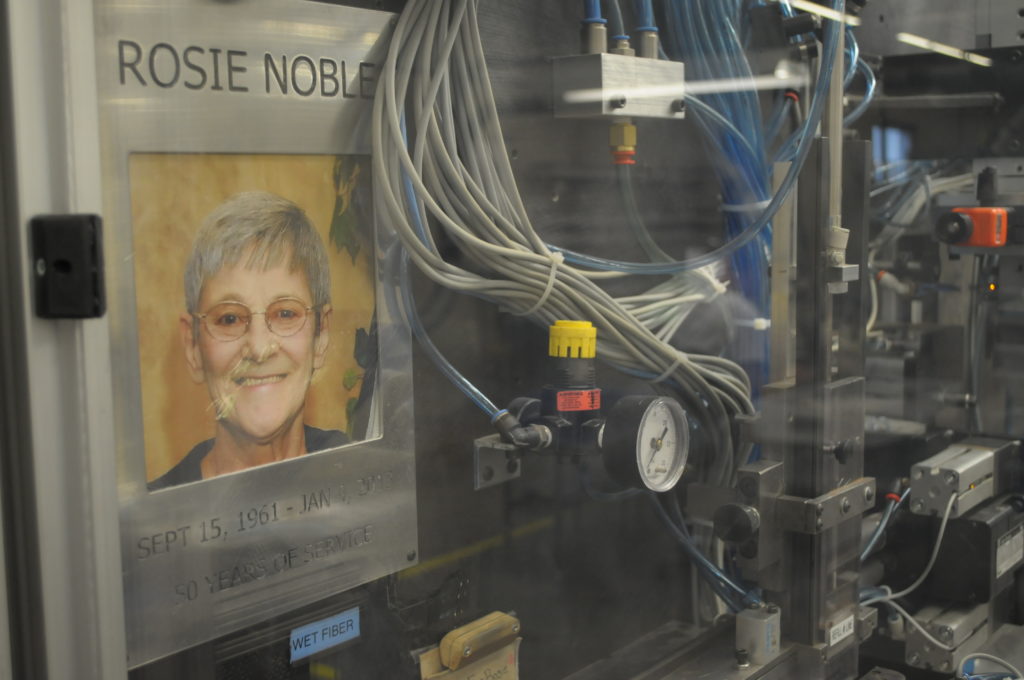
The machine cell has been named Rosie II, in further recognition of a recently retired veteran operator, Rosie Noble.

When Rosie Noble retired after 50 years at Sanderson MacLeod, it was clear that it would be impossible to find a replacement for her. After all, she covered almost seven miles a day walking back and forth in 14-foot lengths making medical stylets. With her retirement fast approaching, a logistical problem became apparent; how to replicate the work she did everyday for 50 years. The engineering team at Sanderson MacLeod began brainstorming how to apply machine and brush making knowledge in order to assist operators to work faster and more efficiently.

“Automation like the Rosie II is only possible when automation is built by people who clearly understand the end product and the various challenges its process requires,” said Mark Borsari, President of Sanderson MacLeod. “Our latest production expansion is yet another successful effort put forth by our engineering team and one they should be proud of. Not only will their efforts give our clients an edge in highly competitive markets, but it will further reinforce our dedication to patient safety through technically superior and consistent cleaning and sterilization products”.

Automation is always a hot button issue in the world of manufacturing. Many see the word and think of layoffs and replacing current employees. At Sanderson, automation serves a different purpose… Technological advancements are utilized by our engineers to give our employees (some of the most experienced and talented brushmakers in the world), new proprietary tools and technology to do their jobs even better than before. It also allows them to spend their time on more crucial components of the brush making process, rather than spending most of their time walking seven miles a day back and forth on one machine, as Rosie once did.

By giving Sanderson operators such a technological advantage, they are able to achieve higher and more predictable efficiencies. These new high capacity production cells are expected to reduce lead times and enhance product offerings including stylet assembly, protective systems and new product design options.

The Rosie II is also capable of being interlinked to Sanderson’s automated Z-Tip machines to augment the existing product with a protective tipping process exclusive only to Sanderson MacLeod. The Z-Tip brush is an exclusive, proprietary innovation which created a new manufacturing process using high-energy, fusion-welding technologies. The result is an entirely new protective brush tip that melts the brush’s preconstructed core wire into a consistent, smooth and inseparable protective tip, known as the Z-Tip.

The Rosie II is yet another example of Sanderson MacLeod reaching outside of the brush industry for inspiration to create proprietary automation solutions for those customers seeking cost effective, superior twisted wire brush solutions.

Whatever happened to Rosie? Well, we still see her around town…Walking, of course. While the machine bears Rosie’s name, it also symbolizes the dedication and hard work the employees of Sanderson MacLeod, Inc. have put in over the last 50+ years.

Sanderson MacLeod is a contract manufacturer specializing in domestically-produced twisted-in-wire products, including twisted-wire medical brushes, firearm cleaning brushes, cosmetic brushes and general purpose cleaning brushes. Established in 1958, the company employs approximately 120 people and operates a modern 137,000 square foot facility in Palmer, MA.